Are the Lord of the Rings Movies Actually Good Adaptations of the Books?
A sentiment analysis of both the novels and movies from Middle-Earth
Project details
Project Requirements
- Explore the texts of the novels and movie scripts.
- Perform sentiment analysis on both.
- Visualize the results and compare the two mediums.
Project Overview
The Lord of the Rings movie trilogy, based on the novels by J.R.R. Tolkien, is among the most well received franchises in the world and won 11 Oscars in total. It is also widely regarded as a great adaptation of the books. The novels themselves rank very high as well and were, at one point, the second bestselling books after only the Bible. Of course, there are differences between the two. Some characters or scenes are left out, and lines from the books are sometimes given to other characters in the movies, for example. I think we can all agree that a word for word adaptation is not possible in the first place. Peter Jackson, the director and co-writer, has stated that:
The themes of Tolkien are another way of honouring the book. Because there’s so much detail that you ultimately can’t recreate. You can’t recreate the world of The Lord of the Rings with everything in the books. But, the thematic material is obviously critically important to translate from book to film. Because the themes are ultimately at the heart of any book.
I want to find out how well the writers of the movies adapted the themes from the novels into the scripts. I should also admit a great deal of bias on my part. I am enamoured with both the books and the movies. Every year, I have at least one movie marathon and can quote them in my sleep. Since I adore them both, this research will either confirm my love for them or completely crush my soul.
The Data
I wanted to analyse the texts of both the novels and the scripts, extended editions of course. I used a .txt file for each. Every word is compared to a lexicon, which is a list of words and the connotation associated with them. All words in the books and scripts are given a score, and the total tells us something about the overall tone of the text. Some lexicons simply indicate how negative or positive a document is, but I used a more nuanced one. The NRC lexicon1 not only shows how negative or positive a text is, but also which emotions are associated with it: anger, fear, anticipation, trust, surprise, sadness, joy, and disgust. By performing a sentiment analysis on both the books and the movie scripts, I can compare them on an emotional level. I used the entire scripts, not just the dialogue, because they also contain descriptions of scenes and the sentiment the filmmakers want to convey.
The analyses were performed using the R programming language. It is great for statistical work and has powerful packages for text analysis. I used the tidyverse package2 to implement transformations and sentiment analysis. First, I collected the contents of both the books and the scripts and cleaned them. I removed punctuation, repeated whitespace, and numbers, for example. Unfortunately, I also had to remove the word “Merry”. This is the name of one of the Hobbits, but it is also a word with emotional meaning, and the analysis would not know the difference. Before extracting sentiments, I wanted to get a quick overview of both trilogies. I created word clouds of the 100 most frequent words to get a sense of the type of texts I was dealing with.
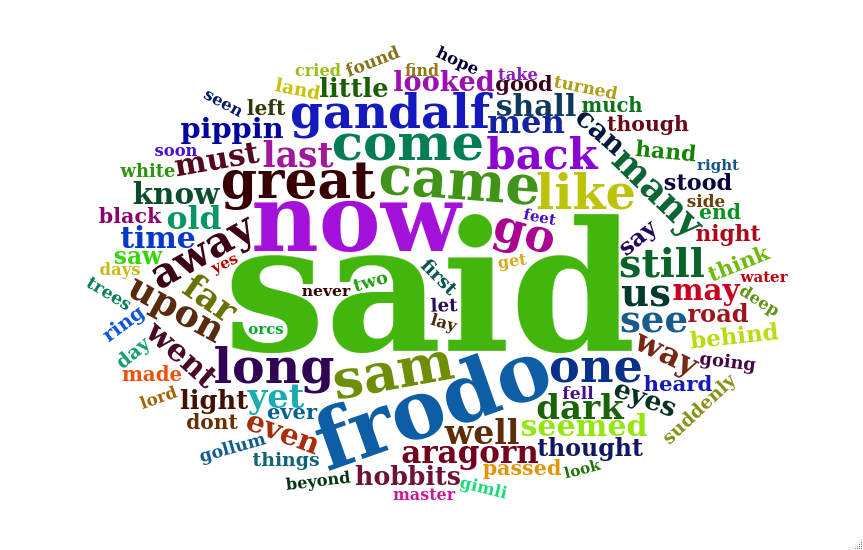
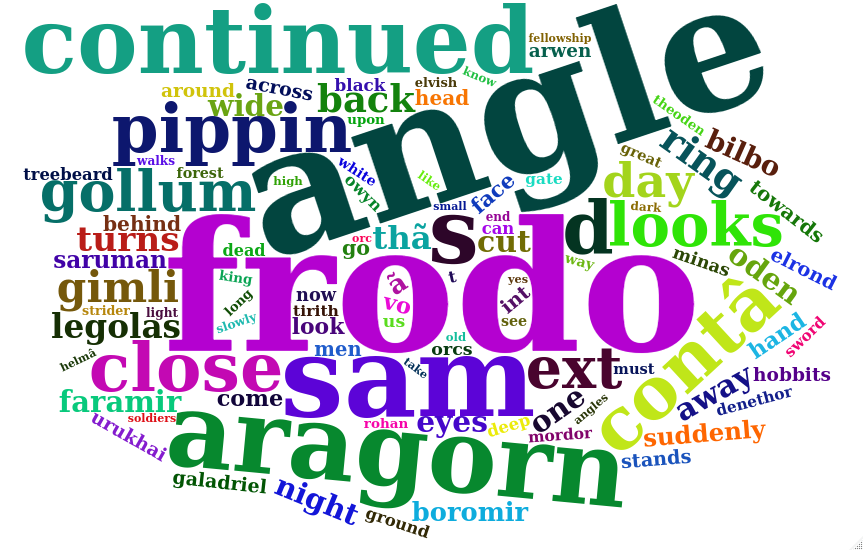
The movie scripts are clearly more technical in nature, which is to be expected. They contain terminology used in filmmaking, while the books are more nuanced in their descriptions of scenes. The 100 most frequent words in the novels are also more evenly distributed, without many extreme outliers in word count. These differences are not surprising, since these are two different mediums. This makes it even more interesting to compare the sentiments expressed through the language used.
Sentiment analysis and comparison
After cleaning the texts, it was time to extract the sentiments and compare them. I wrote three scripts: two to gather sentiments from each trilogy and a third to make comparisons and build a clear plot. I normalized the data so everything was on the same scale before plotting the results. Below are the bar charts for each volume of the trilogies. The bars are sorted in decreasing order based on the sentiments of the books. (Click to expand.)
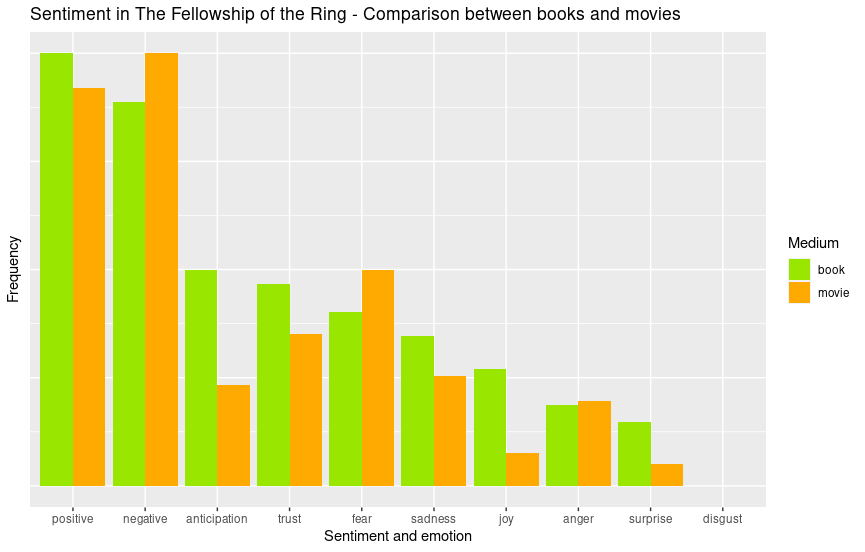
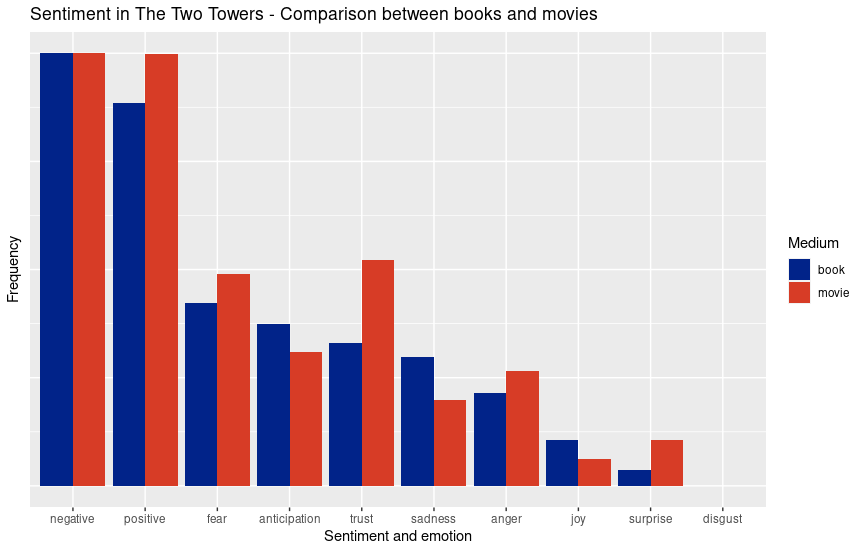
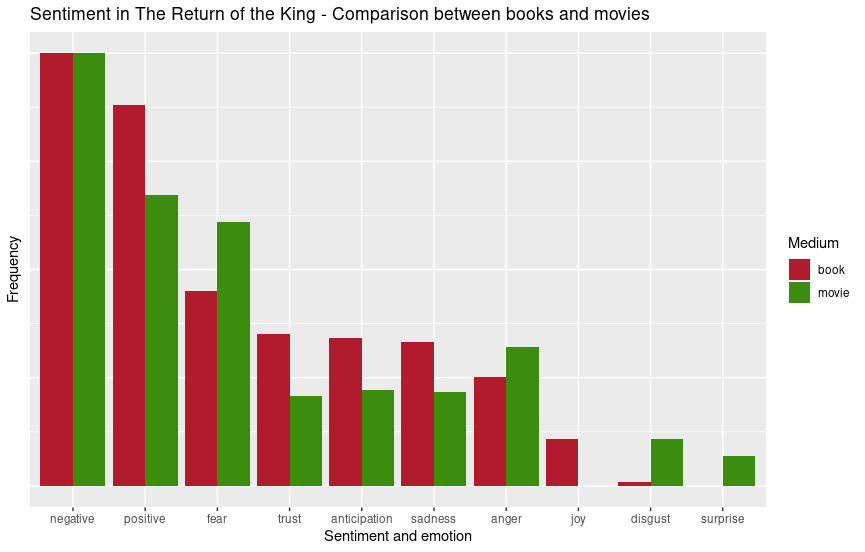
As we can see, the scores are quite similar for most sentiments and emotions. There are some differences, but nothing major. Tolkien was an Oxford professor of linguistics and is undoubtedly hard to compete with. When it comes to positivity and negativity, the two mediums are almost identical. It can also be concluded that trust, fear, anticipation, and sadness are the four most prevalent emotions across both mediums. But which book is the best adapted? Both The Fellowship of the Ring and Return of the King show similarities in 7 out of 10 sentiments. The second volume, The Two Towers, scores 8 out of 10 and is therefore the best adaptation in terms of themes, even though it includes one of the more controversial scenes among book purists (Elves at Helm's Deep?!).
At this point, it is safe to say that the movies did a good job of adapting the books. Both texts carry a similar emotional load. However, one rarely watches just one movie and instead ends up binging the whole trilogy. Tolkien also intended to publish everything as one book. Below is a chart comparing the full trilogy.
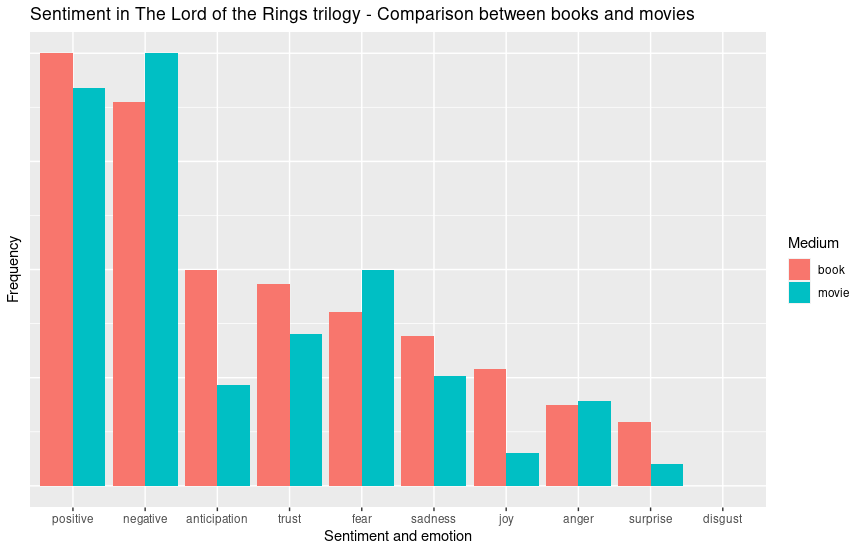
Once again, this is a great result. In 7 out of 10 categories, the books and movies share similar sentiments. It is now even clearer that the appreciation I have for the movies is justified. It is no longer just a gut feeling, but something supported by evidence. This helps explain why, even after two decades, these movies are still considered timeless and are regarded as one of the best attempts to adapt equally popular books.
It is time for me to reread the books and plan another movie marathon.